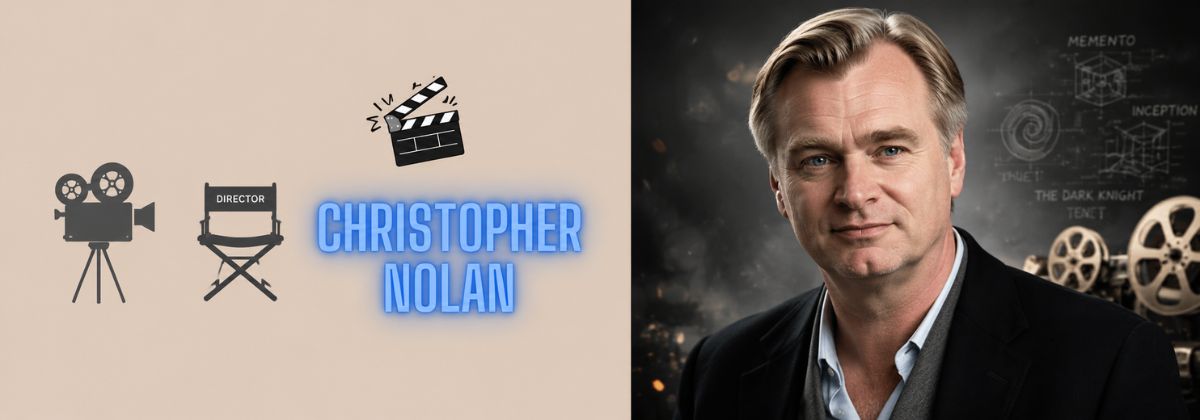
🎬 Who Is Christopher Nolan?
In 1998, a young British-American director released a black-and-white thriller shot on weekends with borrowed equipment and a cast of friends. Total budget: £6,000. That film — Following — was seen by almost nobody. Yet it contained every seed of what would become the most distinctive directorial mind of the 21st century.
Christopher Nolan didn't come from a famous family. He wasn't handed a studio deal. He studied English Literature at Cambridge — not film. He taught himself filmmaking by borrowing a 16mm camera, reading manuals, and simply shooting things. When he was rejected by film schools, he didn't stop. He made his own films anyway.
Today, his films — Memento, The Dark Knight, Inception, Interstellar, Dunkirk, Oppenheimer — have collectively earned over $5.8 billion worldwide. He is one of the few directors in history who can open a film based purely on his name. But the gap between Following and Oppenheimer wasn't luck. It was craft, obsession, and a complete refusal to think like everyone else.

🧠 The Craft Behind the Genius
Nolan's films feel different — not just visually, but intellectually. They reward attention. They treat audiences as intelligent. They leave you thinking for days. None of that happens by accident. It is the result of deliberate, painstaking craft applied at every level of filmmaking.
📖 The Struggles Nobody Mentions
The world celebrates Interstellar and Oppenheimer. It rarely discusses the rejections, the years of obscurity, or the very real risk that Nolan took with every film he made.
| The Challenge | What Nolan Faced | The Lesson for You |
|---|---|---|
| Rejected by Film Schools | Denied entry to the National Film School; had to teach himself entirely | Institutions don't validate talent — your work does |
| First Film, Zero Budget | Following shot on weekends for £6,000 with no professional crew | Constraints breed creativity; start with what you have |
| Studios Wanted Safe Films | Every pitch for original work met with pressure to do sequels and franchises | Originality requires resistance; protect your vision fiercely |
| Mixed Critical Reception | Tenet and Interstellar both received divided critical opinion on release | Work that challenges audiences will always divide them first |
| Years Without Recognition | Three films before Memento made him known; nearly a decade before real fame | The work compounds quietly; keep going before anyone notices |
💬 Nolan's Philosophy: Words That Shape Thinking
- 🌀 "I approach each project with the same attitude: you have to write what you want to see." Nolan has never made a film to please the market. He makes films because the idea genuinely consumes him. The moment you start creating for approval, you lose the thing that made your idea worth pursuing in the first place.
- ⏱️ "I've always been interested in the way in which people are misled by their subjective experience of time." Nolan's entire filmography is a study of how time and memory shape what we believe is real. This is not just a cinematic trick — it is a profound observation about human psychology. The best creators understand people deeply, not just technically.
- 🎬 "When you have something original to say, there's no road map. You have to find the path yourself." Original work, by definition, has no template. Nolan's non-linear storytelling had no predecessor to copy. He invented the language as he went. If you're doing something truly original, the absence of a map is not a problem — it is proof you're in the right place.
- 🧠 "I only make films about things I genuinely don't understand, that I'm trying to figure out." Nolan uses filmmaking as a tool for thinking. Interstellar is him wrestling with love and physics. Oppenheimer is him wrestling with moral consequence. His uncertainty becomes the engine. Don't wait until you have answers — create to find them.
- 🔦 "The audience is the final ingredient in any piece of cinema." Nolan refuses to explain his films with exposition — he trusts viewers to follow, to feel, to interpret. Great work trusts its audience's intelligence. Don't over-explain. Don't underestimate the people you're creating for.
- 💡 "Every film should work on multiple levels simultaneously." The Dark Knight is a superhero film, a crime epic, a moral philosophy lecture, and a post-9/11 allegory — all at once. The greatest creative work operates on the surface for casual audiences and at depth for those who look harder. Build things with layers.
- 🎞️ "I believe in shooting on film — because the image quality is simply better." In an industry obsessed with convenience and cost-cutting, Nolan chooses the harder medium because it produces the better result. Don't choose the shortcut when the longer road yields something genuinely superior. Quality is always the argument.
🎓 7 Life Lessons from Nolan's Journey
"The most important thing for any film, for any story, is that it should be surprising. The moment an audience thinks they know where you're going, you've lost them. But if you take them somewhere they didn't expect to go — and make them feel that it was inevitable — that is when cinema becomes something else entirely."
🎬 Your 'Nolan Moment' Is Waiting
Christopher Nolan shot his first film on a borrowed camera on weekends, with no money, no studio, and no audience. He is now one of the three or four directors in the world whose name alone guarantees a cinema audience of millions.
The distance between those two points was not talent alone. It was twenty-five years of working on craft, refusing to compromise on originality, and making the film he wanted to see regardless of whether the industry wanted him to make it.
You don't need to make films. But you do have something to say, something to build, something to create that the world doesn't yet have. The question is whether you will trust that idea enough to pursue it without permission, without a road map, and without knowing where it leads.
- A student who writes the essay no one expected and changes the way the class thinks about the subject.
- A developer who builds an app that solves a problem nobody had articulated yet.
- A musician who refuses to make the kind of music that gets streams because the music they hear in their head is something else entirely.
- A teacher who restructures the lesson so that students feel something, not just learn something.
- A storyteller who understands that how you tell a story is as powerful as what the story is.
🎬 Your Challenge: Think Non-Linearly This Week
Take one project you're working on — a presentation, an essay, a piece of work, a problem — and deliberately ask: what if I started at the end? What if I told this differently? What is the theme, not just the content? Nolan began by questioning structure. You can too.
Your Vision Deserves to Exist
Don't wait to be discovered. Don't wait for permission. Nolan borrowed a camera and started. Your version of that camera is already in your hands.
vibeshub is built for people who think differently — who want to create things that matter, tell stories that surprise, and build a future worth watching.
🎬 Start Creating — Make Something Original