 VIBE Ed
← Back to Home
VIBE Ed
← Back to Home
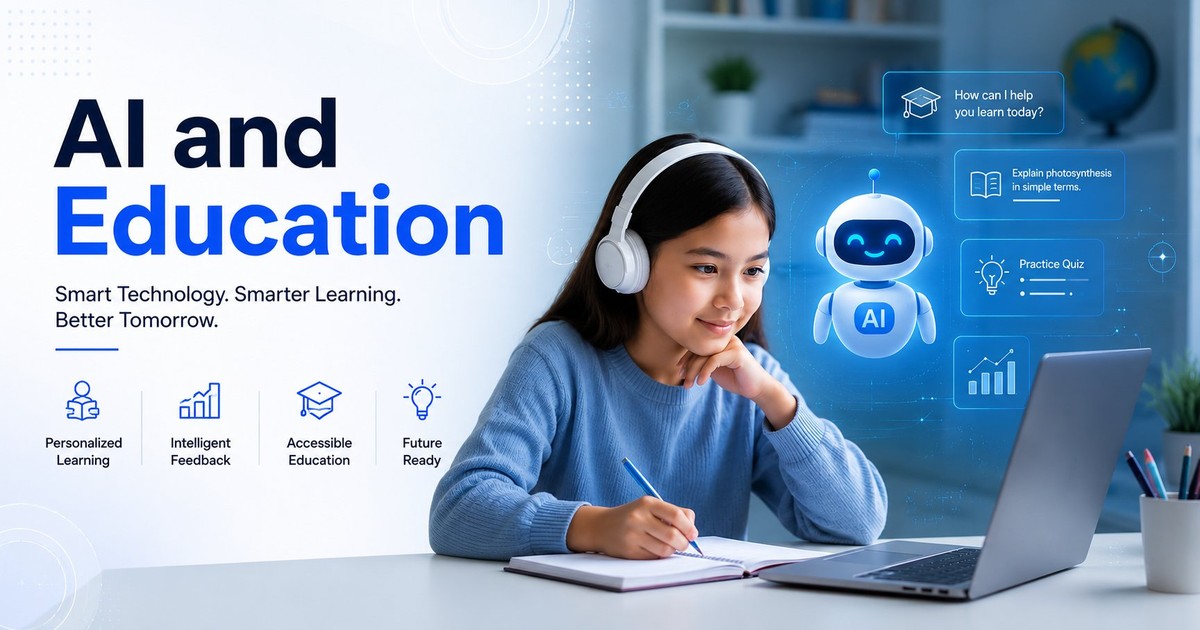
From chalkboards to chatbots, from textbooks to intelligent tutors — how Artificial Intelligence is fundamentally reshaping how the world learns, and what it means for every student in India today.
A decade ago, "artificial intelligence in education" sounded like science fiction. Today, millions of students open AI-powered apps before they open their textbooks. The classroom is being redesigned — not by architects, but by algorithms. Here is the full story of how we got here, and where we are going.
The idea of using machines to assist learning is older than the internet. But it was only in the last decade — with the explosion of big data, affordable computing, and breakthroughs in machine learning — that AI moved from experimental labs into real classrooms. Understanding this evolution helps us appreciate just how fast the change is coming.
Early programs like PLATO allowed students to interact with computerized lessons. These were rule-based — no true intelligence, just branching scripts — but they planted the seed of technology-aided learning.
Researchers built systems that could model student knowledge and adapt questions accordingly. Carnegie Learning's Cognitive Tutor showed that adaptive math tutoring produced measurably better outcomes than one-size-fits-all teaching.
Platforms like Coursera, edX, and Khan Academy brought learning online for millions. The data these platforms collected — every click, pause, rewatch, and mistake — became the training ground for smarter AI models.
Large language models (LLMs) like GPT-4, Claude, and Gemini changed everything. Now any student could have a conversation with an AI that explains, adapts, quizzes, corrects, and encourages — in any language, at any hour, at almost no cost.
The impact of AI on education is not a future event — it is already happening, in ways both dramatic and quiet. Here are the six most significant changes AI is driving in classrooms and study rooms today.
AI systems analyze how a student answers questions — speed, accuracy, pattern of errors — and build a custom learning path unique to that student. No two students see the same sequence of content.
Students no longer need to wait for a teacher to clear doubts. AI tutors like VIBE AI, Khan Academy's Khanmigo, and Chegg's CheggMate answer questions instantly — and explain concepts in multiple ways until the student understands.
AI can generate thousands of high-quality MCQs tailored to specific exam patterns — JEE, NEET, EAPCET, TET, UPSC — with correct answers, detailed explanations, and difficulty tagging. Teachers save hours; students get more practice.
India has 22 official languages and hundreds of dialects. AI translation and voice technology now allow the same high-quality educational content to be delivered in Telugu, Tamil, Marathi, Bengali, or Odia — instantly and accurately.
AI powers block-based coding games, interactive simulations of physics experiments, and virtual chemistry labs. Students who would have disengaged from a static textbook stay curious and active in an AI-powered learning environment.
AI gives teachers dashboards that show — at a glance — which students are struggling, which topics the whole class is failing, and which students are at risk of dropping out. Teachers can intervene with precision instead of guesswork.
AI-powered classrooms are no longer a vision — they are a reality for millions of Indian students today.
"AI is not replacing teachers. It is giving every teacher a superpower — to know every student deeply, and to help every student brilliantly."
— VIBE Editorial, 2026Nowhere is AI's impact on Indian education felt more sharply than in competitive exam preparation. JEE, NEET, UPSC, EAPCET, TET — these are high-stakes, high-pressure exams that determine the futures of millions of students. AI is reshaping how students prepare for all of them.
Personalised Mock Tests: AI generates full-length mock exams modeled on the real exam pattern — with previous year question trends, topic weighting, and time-pressure simulations. After each test, it produces a detailed report showing exactly which chapters to revise.
Concept Gap Detection: When a student consistently gets a particular type of question wrong, AI traces it back to the foundational concept they are missing — and serves targeted micro-lessons to fill that specific gap, not the whole chapter.
Rank Prediction & Study Planning: Using historical data from thousands of previous toppers, AI can predict a student's likely rank based on their current performance — and then generate a precise, day-by-day study plan to close the gap before exam day.
Voice-Based Doubt Solving: Students studying in Telugu, Hindi, or any regional language can now speak their doubt aloud — and receive a clear spoken explanation in their own language, powered by AI speech recognition and synthesis. No language barrier, no hesitation.
The Equity Argument: Until recently, high-quality JEE and NEET coaching was available only in big cities — Hyderabad, Kota, Chennai, Delhi — to students whose families could afford ₹1–3 lakh per year in coaching fees. AI-powered platforms are changing this equation. A student in a small town in Vizianagaram or Warangal can now access the same quality of preparation as a student at a premium Hyderabad coaching centre — for a fraction of the cost. This is one of the most important equity shifts in Indian education in decades.
It would be dishonest to paint AI as a perfect solution. There are real, significant challenges that must be acknowledged — especially in the Indian context.
The Digital Divide: AI-powered education requires a smartphone or computer and reliable internet access. Millions of Indian students — particularly in rural areas, tribal regions, and low-income urban households — lack both. Without deliberate policy intervention, AI risks widening the gap between the privileged and the underserved.
Hallucination and Accuracy: AI tutors can sometimes provide confidently wrong answers — what researchers call "hallucinations." In high-stakes subjects like Physics, Chemistry, and Biology, a single wrong explanation can mislead a student for weeks. AI platforms must be rigorously tested and validated before being trusted for exam preparation.
The Human Connection Gap: Teaching is not only about information transfer. A great teacher notices when a student is anxious, celebrates their wins, and builds their confidence in ways that go beyond content. AI cannot yet replicate the emotional intelligence of a caring human teacher — and students who rely entirely on AI may miss the mentorship dimension of real learning.
Data Privacy and Student Safety: AI platforms collect enormous amounts of data about student behaviour, performance, and even emotional state. Proper data protection laws, especially for minors, must keep pace with the technology. Parents and students have a right to know exactly what data is collected and how it is used.
If you are a student in India today — whether you are preparing for JEE, NEET, EAPCET, a state PSC, or simply learning to code — here is what the AI revolution means for you practically:
You have access to tools that the previous generation did not. Use them. AI tutors, practice platforms, adaptive tests, and multilingual explainers are available today — many for free. Not using them is leaving a significant advantage on the table.
But do not outsource your thinking. AI is a tool — like a calculator. Just as a student who only uses a calculator never truly understands mathematics, a student who only asks AI for answers never builds the deep understanding needed to crack competitive exams. Use AI to understand, not to copy.
Learn to work with AI — not against it. The jobs of the future will require people who can collaborate with AI systems. Students who understand how to prompt, evaluate, and apply AI outputs will have a profound advantage in the workforce over those who are afraid of the technology.
Your curiosity is still your greatest asset. AI can deliver information, but it cannot deliver passion. The students who will thrive in the AI era are those who are genuinely curious, who love solving problems, and who are willing to keep learning even when it is hard. No algorithm can replace that hunger.
The evolution of AI in education is not a distant trend — it is happening in classrooms, on smartphones, and in study rooms across India right now. It is making quality education more accessible, more personalised, and more effective than ever before in human history. But technology is always only as powerful as the human intention behind it. AI will not educate anyone — curious, persistent, brave students will educate themselves, using AI as one of the most powerful tools ever built. The question is not whether AI will change education. It already has. The question is: will you use that change to become your best possible self?